Sunday, November 16, 2008

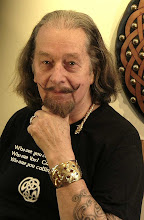
You may or may not have noticed the Triple question on my Tee-shirt, "Who are you calling a Celt ?" and "Who are you ? Calling a celt."or "Who are you calling? A Celt."

The map from the National Geographic May 1977 gives a perfect overview of all the peoples of Europe that are considered to be of Celtic origin.It also shows many of the artifacts had been uncovered up until then. As archeaology continues in many places all over Europe, more and more is coming to light.The Hochdorf princely grave site being one, and the discovery of the body of "Otzi" in high Alps of Austrian- Italian border has given us a much clearer insight into who and what these people were and how they lived.

More currently it has been my privelege to meet with some of the more reknown Celtic Artist of the 20th century.In alphabetical order Courtney Davis, whom I met for the first time at Scrif Celt in London,and the on another occasion we met during the "Work of Angels" exhibition at the British Museum at the time that we both met Janet Backhouse, author of "The Lindisfarne Gospels". And again in Cornwall at the Royal Swanery near Abbotsbury after visiting Maiden Castle, one of the largest Celtic hillforts in the U.K.You can check out Courtney's art in the many books that he has published by Blanford Press.

Next is Jim Fitzpatrick, whose art I fell in love with many years before I met him.Posters and cards used to abound in many stores along Oxford street in London. However it was the books that he published through Paper Tiger, a division of Dutton Books, that really caught my attention. "Erin Saga", "The Book of Conquests" and "The Silver Arm" making reference to "Nuada" a Celtic hero who lost his arm in a battle and then had an artificial arm made.
The image you see here is from one of the most famous of his books, "Celtia",in this book you can clearly see how Mucha influenced him."Macha" and "Morrigan" are not unlike "Music" and "Poetry" both from Mucha in 1898.The Art Nouveau is replaced with some very intricate Celtic art work and faces from Celtic mythology. In the same book is a cover for a record album for Alen Stivell with his harp. Then "Thin Lizzy" with" Johnny the Fox and a real break from tradition with Jailbreak also for "Thin Lizzy" A clear indication of a definite evolution of art styles.I'll come back to Alan further on in my disertation.

Earlier on in one of my first 'posts' I made mention of Aidan coming into my shop and inviting me to join his Celtic Art classes. I have to say that along with George Bain, he has been the strongest influence on my development with Celtic art. Since he lived in Vancouver like myself, it was a natural that I should attend his classes for quite a period of time. Upon reflecting on this period I find I have some of the very early class notes that Aidan gave his students.The original "Coracle" Vol.1 #1 dates from January 1983 typed in 8.5x5.5 inch carried on till the following year in Vol.2 when he started to do the lovely hand scripted Coracles that eventually evolved into the series on Celtic art that were published by Thames and Hudson.
On a couple of occasions I was priveleged to carry the original works for delivery to T&H in London. The last one that I took over, I was allowed to add a punctuation mark to one of the pages. Not unlike the feeling that I got when I took my children on a hike through Germany and we stopped at the Gutenberg Museum in Mainz and was asked to press one of the pages using the press that was used to create the Gutenberg Bibles.


Last but not least, as the music of Alan Stivell plays in the background,I recall the Celtic Festival in Vancouver, July 6-8-1990. I had the pleasure of hosting Alan's visit whilst he was here. On a subsequent occasion he and his wife played host to Gretchen and I while we were in France. We had a personal tour of Rennes and the Brociliande Forest, from whence Lancelot is said to hail.

Wednesday, November 12, 2008

Lindisfarne Bracelet


In the broadest general terms, inspiration come from the work of others. In this case I was so absorbed in the book by Janet Backhouse, "The Lindisfarne Gospels" from Phaidon Press,Oxford, in association with the Britsh Museum.
I admired the original book on display which is opened to one page only.
This is also the case with the Book of Kells, at Trinity College, Dublin, which by the way does turn the pages on a daily basis. Trinity College Press also has some magnificent plates of the illuminated pages.
Having studied the Lindisfarne Gospels, I admit that the tiny panel on the right hand side of folio 27, the opening of St.Matthew, escaped my attention.
In the book it measures a mere 7x45mm, it is right besides the R of "Liber Generationis Iesu Christi filii David.....".


Scanning the page and enlarging that section I was able to make it fit the measurements of the bracelet, 80x20mm. It is made from 16 gauge or 0.05mm sterling silver. The problem is that to transfer the design to the metal prior to engraving requires a new transfer for each bracelet, this being the case it does make each one rather uinique in that minor differences in the tracing also transfers to the engraving.


To the left you can clearly see the end result, a 2cm wide brcelet in sterling silver with the two dogs and birds deeply engraved and the stippled background to make the design standout.
It is with regret that between the time that I met Ms.Backhouse and the time that I made the bracelets, she passed away. I believe that she would have been very pleased to see how her book has inspired me and many others.


Tuesday, November 11, 2008

The Mandolin Project


When first I started I started on this buckle I had no idea where it would sell or the type of belt it would go with. I just loved the colouring in the Turquoise, a 30x22mm cabochon, it required something special. So my thinking was along the lines of a simple Celtic knotwork to flank the stone and then wait for some inspiration. Well.............,inspiration like money does not grow on trees. So the best thing is to leave well enough alone, and get on with something else.

As luck would have it, I did not have to wait very long. Alan Martin came to me some time ago for a hand bound book to write his music in, that's a story for another day, but he asked if I could make him a strap for a mandolin. Not just any mandolin, as soon as he opened the case, I was struck with the excuisite workmanship of this instrument.
It did not take long for us to decide on a pattern and colour for the strap, but the fastener was a wee bit of a problem. It had to be adjustable, but when in use it should not move. Alan caught site of the buckle and it was just a matter of deciding how best to attach it and still make fully adjustable. The pin on the buckle was adequate, but it was not inconceivable that it could slip out during a performance. After Alan left I started to ponder the problem and decided that a screw would best ensure that it did not come out of the hole on the belt. As is the case with most small things, they are easily lost and often fiddly to handle. Tap the pin, make a screw, put a bow on the screw and attach a chain. Well as might be expected the chain twists with the screw. So a lobster catch and a bit more chain and all is secure and ship shape.

Here is Alan with Mandolin ans strap in my workshop. The colourof the strap blends very nicely with the stock on the mandolin and my buckle is prominently displayed. Another happy customer and what a pleasure it was find such a novel way of securing the belt.


Sunday, November 9, 2008

Celtic Origins

The constantly re-occuring question is "What is Celtic".

The answer to that is complex and elusive, as were the Celts. Most publications on the subject will mention that they were the people who inhabited Europe west of the river Danube all the way to the west coasts of the British Isles and Ireland. Based on what you might ask?Archeology has over the last centuries found links among many different locations and these all based on materials that have survived burial for thousands of years. There are few things that survive interment for that long, pottery and gold being among the best. Rock carvings are another, but all are subject to the wear and tear of time and weather.

In all of the things that do survive there has been a link in the decoration of the items that are found. They were given names like "Hallstatt","LaTene" early and late "Bronze Age", "Iron Age", etc, etc.

Having been born in the Netherlands, you might think my schooling would have exposed me to countless bits of information about the early inhabitants of the area. Well, on the contrary, a brief reference to the Cannifates and Batavi is all that I remember. Subsequent schooling in Belgium, France and Scotland did little to enlarge my knowledge on the subject of Celtic art, history, music or legends.

Not till many years later whilst running a craft shop and working on leather did a request for a music bag with an image of three interlaced figures to be tooled on the flap ignite my interest. This ostensibly was to represent three musicians for whom the bag was to be made. To me the image looked rather lonely, so after a little research I found a suitable design to enhance the flap of the bag. I still had no idea about Celtic art and this was a Greek key pattern that intertwined. It turns out the musicians decided to call themselves the "Celtic Circle", and to close this circle I received a dalmatian puppy that we called "Celtic", with a soft C rather that the usual hard C as in Celtic, since it was a female puppy.

From there I found George Bain's book on Celtic Art, and a wee while later Aidan Meehan wandered into the shop with his baby daughter because he saw a book cover of mine in the window with a Celtic design. The bairn went straight for the dogs ears, but the dog was not having any of that. She continued to evade the little girl and I finally called the dog into the workshop that was separated by a railing from the set of the Robert Altman's film "McCabe & Mrs.Miller" that had been filmed nearby. "Celtic here" and the dog was glad to escape, but Aidan hearing the soft rather than the hard C, asked my about my designs and before long invited me to join his Celtic Art classes.

Well, I'm still using the lessons that he taught and I have since traveled to most of the Celtic sites in the world, from Hallstatt to Neuchatel, Bibracte, Bobbio, Lutetia, Alesia, Rennes, Kells, Durrow, Dun Aengus and many more. My library on Celtic books now exceeds 350 volumes and hundreds - if not thousands of slides and pictures from museums and sites all over Europe.

I am now inextricably enmeshed in the pursuit of all things Celtic, and I hereby warn others, once you enter this maze, you may never leave.